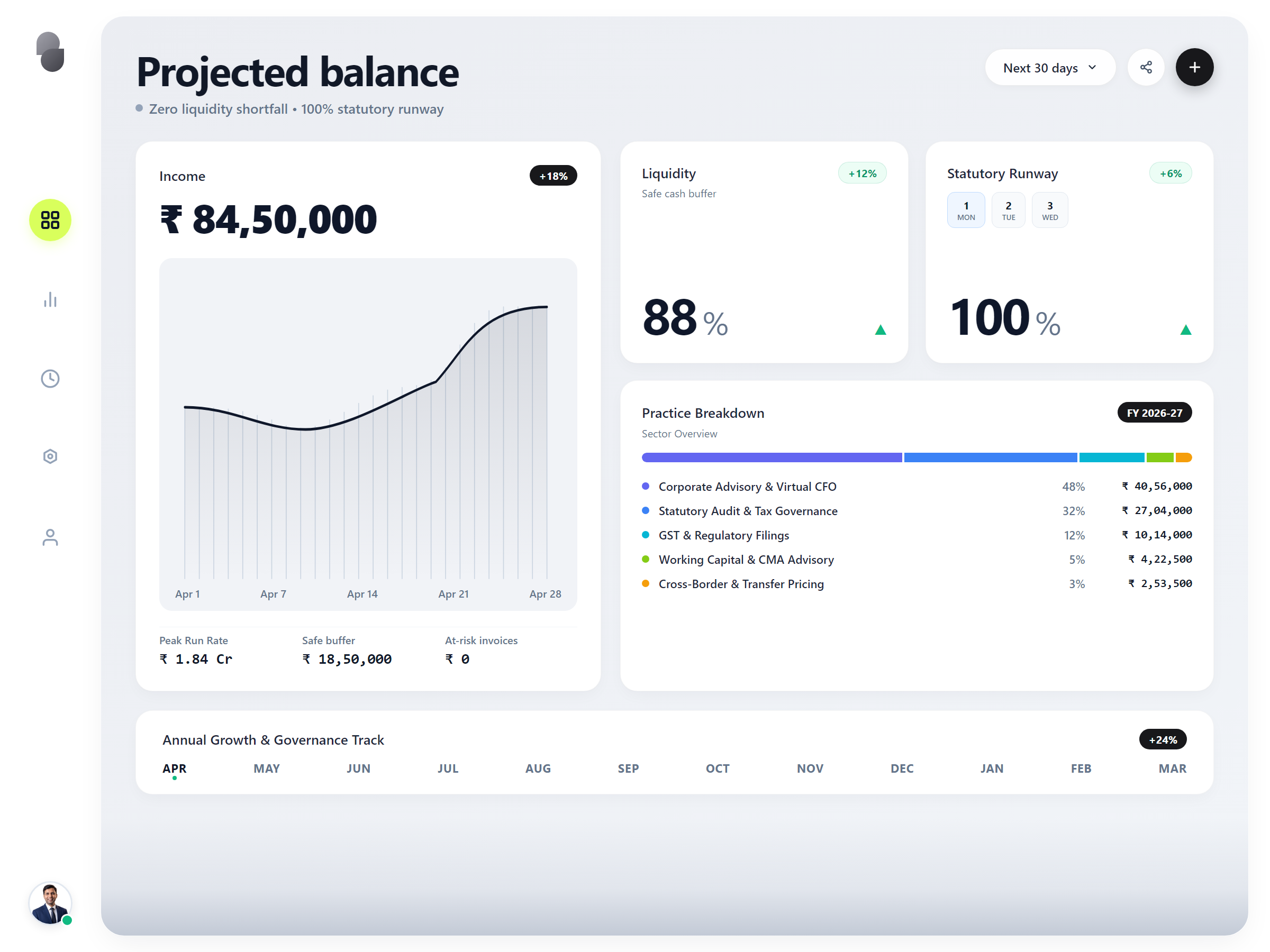
What a Virtual CFO Does vs. Routine Accounting: Strategic Financial Leadership
Risk Mitigation & Solvency

Why traditional bookkeepers cannot deliver enterprise financial leadership. Understanding the critical operational differences between routine compliance accounting and high-impact Virtual CFO advisory.
"“Accounting records where your money went in the past. Virtual CFO leadership directs where your capital should deploy tomorrow.”"
The Three Tiers of Enterprise Financial Management
- Tier 1 - Transactional Accounting: Data entry, sales invoice generation, bill booking, monthly bank reconciliations, and payroll processing.
- Tier 2 - Statutory & Regulatory Compliance: Timely filing of GSTR-1, GSTR-3B, TDS payments, Advance Tax computations, and preparation of trial balances.
- Tier 3 - Strategic Virtual CFO Leadership: Capital budgeting, banking consortium negotiations (CMA data/DPR), pricing elasticity analysis, Board MIS governance, and cash runway preservation.
When Should Your Enterprise Engage a Virtual CFO?
Engaging an institutional Virtual CFO practice becomes imperative when company turnover crosses ₹5 Crore to ₹100 Crore. At this scale, mistakes in tax structuring, working capital management, or bank credit covenants directly endanger promoter net worth. A Virtual CFO delivers boardroom-grade expertise at a fraction of the cost of a full-time executive CFO.
📋 Professional Practice Advisory Note
Lav K Sharma & Co., Chartered Accountants delivers specialized Virtual CFO advisory, corporate debt structuring, statutory audit management, and direct tax compliance across India. For confidential consultation with our partners, connect directly with our office.
The 13-Week Rolling Cash Flow Forecast
Annual budgets are insufficient for managing working capital volatility. Well-run corporate finance desks rely on a rolling 13-week cash flow model updated every Monday morning:
- Weeks 1 to 4 (Deterministic): Known customer collection commitments, confirmed payroll obligations, statutory tax liabilities, and fixed vendor payouts.
- Weeks 5 to 8 (Operational): Anticipated project billing milestones, scheduled raw material purchases, and advance tax tranches.
- Weeks 9 to 13 (Strategic): Projected seasonal sales inflows and planned capex disbursements.
By rolling this 13-week projection forward each week, a liquidity shortfall is visible 8 to 10 weeks in advance—providing ample runway to adjust procurement, accelerate debtor recovery, or arrange promoter loans.
See also



Strategic Financial Leadership & Advisory
Lav K Sharma & Co. delivers Virtual CFO leadership, corporate tax planning, and statutory compliance discipline to growing enterprises across India.